The Physics of Precision
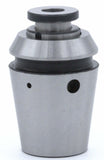
160-M4.0The Physics of Precision: How Modern Collet Technology Transforms Milling Performance
Think of your milling operation as a high-speed orchestra where every component must perform in perfect harmony. At the heart of this mechanical symphony sits an often-overlooked conductor: the collet. While it might seem like a simple clamping device, the collet's role in managing vibration dynamics and force distribution can make the difference between a pristine surface finish and costly scrap.
Understanding the Harmonic Challenge
Every rotating tool creates vibrations—it's basic physics. When your spindle spins at 10,000 RPM, even a microscopic imbalance generates forces that compound exponentially. These vibrations manifest as chatter marks, premature tool wear, and dimensional inconsistencies. The mathematical relationship is unforgiving: a mere 0.0001" of runout at the collet translates to measurable surface roughness variations and can reduce tool life by up to 40%.
The Science of Superior Grip
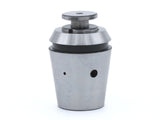
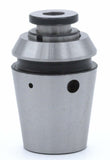
Centaur Precision Tools approaches collet design through the lens of material science and mechanical engineering. The key lies in understanding elastic deformation under load. When a collet grips a tool shank, it must distribute clamping forces uniformly across the contact surface—imagine the difference between gripping a pencil with your entire hand versus just your fingertips.
Our collets achieve concentricity levels within 0.0002" TIR (Total Indicator Reading) through a combination of:
- Precision grinding that maintains geometric tolerances tighter than a human hair's width
- Optimized taper angles calculated to maximize surface contact without inducing stress concentrations
- Heat-treated alloy steel that maintains dimensional stability under thermal cycling
The Vibration Damping Effect
Here's where it gets interesting: a properly designed collet acts as a vibration damper. The interference fit between collet and tool shank creates what engineers call a "friction interface"—a boundary that dissipates vibrational energy as heat rather than allowing it to propagate through your machine structure.
Laboratory testing reveals that high-precision collets can reduce vibration amplitude by 35-50% compared to standard ER collets. This isn't just marketing speak—it's measurable using accelerometers and frequency spectrum analysis. The result? Surface finishes improve from Ra 32 to Ra 16 or better, and those irritating harmonic lines disappear from your parts.
Real-World Performance Metrics
Consider this scenario: machining 316 stainless steel at 600 SFM with a 0.5" carbide endmill. With a standard collet showing 0.0008" runout, tool life averages 45 minutes before edge breakdown. Switch to a precision collet with 0.0002" runout, and suddenly you're pushing 75 minutes—a 67% improvement. That's not luck; it's the predictable result of reducing dynamic loading on your cutting edges.
The Investment Equation
Quality collets represent a fascinating economic paradox: they're simultaneously one of the least expensive components in your tooling system and one of the most impactful on your bottom line. When a $150 collet can extend the life of $300 cutting tools by 50% while improving part quality, the ROI calculation becomes compelling.
The next time you're troubleshooting surface finish issues or fighting tool life problems, remember that the solution might not require new machines or exotic coatings. Sometimes, precision starts with the fundamentals—and in milling, it doesn't get more fundamental than how you hold your tools.
Ready to quantify the improvement in your own operations? The difference is measurable, repeatable, and waiting to transform your milling results.